
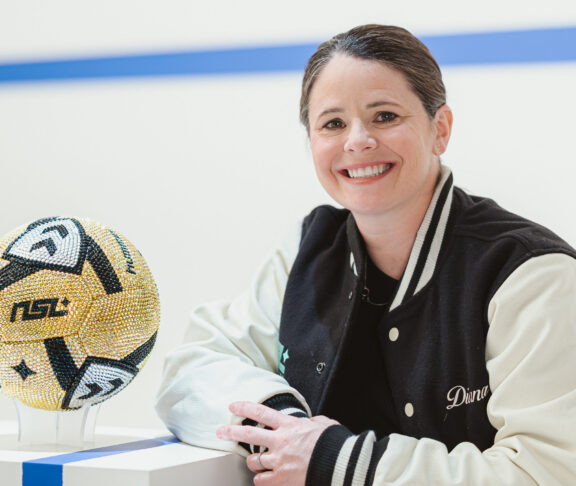
Founder of the NSL, Diana Matheson, speaks on moving the needle for women’s sport in Canada.

Tell me about the origins of the Northern Super League. How did you get the idea to start Canada’s first professional women’s soccer league?
My background was as a player. I spent 17 years playing professionally, and like most Canadian soccer players, I spent my career abroad. We leave after high school to play in the NCAA, Europe or the United States.
When I was on the women’s Canadian national team, there was an evolving conversation about how other countries were investing in their own professional leagues. We would always ask, “When is ours coming here in Canada?”
When I retired at the end of 2020/beginning of 2021, I thought I could finally get to move home back to Toronto, get a job, and build a life in Canada. But there were no jobs for me in women’s pro soccer. My friends who’d retired were having to move back abroad to Mexico, the U.S., or Europe to work in women’s pro soccer.
I thought someone was going to start something soon, it felt inevitable. During the last Women’s World Cup, only two out of the 32 countries that competed didn’t have a women’s pro league yet – Canada and Haiti. It felt like something must be coming.
I went back to school, completed my executive MBA at the Smith School and a soccer master’s through UEFA. Over those two years, when I was just a full-time student doing individual projects on the feasibility of women’s pro soccer in Canada, it became really clear how we could build in Canada. We had to start immediately because the women’s pro sport market was growing quickly.
After speaking to people in the soccer landscape, I learned that no one was working on anything. I decided to give it a push myself. In 2022, my business partner, Tom Gilbert, and I founded Project 8.
That was the beginning. It went from knowing it needed to happen to figuring out how it could happen. The only good option was to build an independent league by former players, for players.
For years, Canadian girls have always had to look overseas to pursue professional careers. What does it mean that they can now find that pathway in their own backyard?
It was always about more than just the players. There’s a whole ecosystem around pro sport. We wanted to create jobs for players, coaches, referees, women in sport business, sport media, and sport medicine from coast to coast.
It was clear that if we just placed a few Canadian teams in a U.S. based league, we’d only have a team in Toronto and Vancouver. We’d only be impacting a few players, coaches, and referees.
We have one of the biggest player pools for women in the world. We had to make sure we were developing more professional players if we wanted to keep winning Olympic medals and World Cups. We had to build a league. It was the only way to really provide those opportunities and pathways for soccer players across Canada.
How important is representation, such as seeing women, in coaching, leadership, and ownership roles?
Girls in Canada start participating in sports at the same age as boys, but the dropout rate is much higher. One reason is the lack of visible pathways for girls and women.
Girls don’t have role models who are visible. By adding the Northern Super League, we want to move the needle by creating visible role models from coast to coast. There are over 130 players in this league, giving every little girl in Canada someone that they can identify with and aspire to be. With our teams being across Canada, we have teams and coaches that are interacting with their local communities.
How is the NSL getting involved at a grassroots level to help the next generation of female athletes?
At the league level, our national broadcast partnerships with CBC and TSN are important. Whether you have an NSL club in your market or not, young fans can watch us. Matches are also available on NSL’s YouTube channel for free.
Locally, our teams interact with grassroots soccer day-to-day. Young players can always get autographs after the games or watch open training sessions.
It’s our clubs that are the ones on the ground interacting with those grassroots communities and making that difference day to day.
Where did you see the biggest gaps in access and opportunity for girls and women in Canadian sport?
We can all tell it’s a great time for women’s pro sport right now, but there are still lots of gaps.
With the three pro women’s leagues now operating in Canada, we see more investment, visibility, and shifting cultural attitudes. But absolutely, there are still gaps because it’s still so new.
At the grassroots level, we face challenges in getting equal access to fields or access to coaches. At the pro level, the systems, structures, and institutions that are built around pro sport in this country were built for men’s pro sport. Sponsorship algorithms are built off of men’s broadcast numbers. There is not a lot of default coverage for women’s sport, and we still have to remind people every day we’re out there.
Looking ahead, what gives you the most hope for the future of women’s sport in Canada?
We’re in a new era, and the future is going to look so different than anything we’ve seen before. What gives me the most hope is where the women’s pro sport industry in this country is going.
We’re only three and a half years into women’s pro soccer in Canada. This is a business that’s going to keep growing and attracting investment. Canada supports women and girls participating in sport at world-leading levels. You see it every Olympics, where the majority of medals are won by women for this country.
Canada has the potential to build one of the biggest women’s sport economies in the world. It’s a unique area that drives economic benefit and growth in a time we’re talking about investing in Canada.
There are also positive outcomes that come with driving equity and participation in sport, lowering healthcare costs, and creating the next generation of leaders.
It’s a great time to be in women’s sport, and we’re just getting started!
Follow the Northern Super League on Instagram,
instagram.com/northernsuperleague

